

Consistent steel cleanliness starts with consistent process control, and few variables affect cleanliness more directly than what enters the tundish during ladle draining.
For operations that still rely on manual visual observation to identify slag carryover, process control has a ceiling. Visual detection depends on what an operator can see, when they see it, and how quickly they respond. By the time slag becomes visible, it has already entered the tundish. The impact on inclusion levels, nozzle performance, sequence length, and heat-to-heat consistency is already underway.
Steelmakers focused on quality tons, caster productivity, and yield optimization require detection methods that identify the onset of slag carryover before meaningful contamination occurs—not after. The Kiss Technologies Ladle Slag Detection System replaces operator judgment with continuous, objective process monitoring, helping steelmakers reduce slag carryover while improving process consistency, heat-to-heat traceability, and operational performance
What Is Visual Slag Detection?
Ladle slag detection is the continuous monitoring of the steel stream during ladle draining to identify the onset of slag carryover and trigger a timely response before significant slag enters the tundish.
In operations that rely on manual visual observation, monitoring depends on operators recognizing changes in the steel stream’s appearance, including shifts in color, flow behavior, surface turbulence, or visible slag particles.
Automated systems instead monitor objective process signals to identify the beginning of slag carryover earlier and with greater repeatability than visual observation allows.
The distinction matters because steel cleanliness is a heat-to-heat discipline. Detection methods that perform differently between operators and shifts introduce variability that appears directly in inclusion analysis, nozzle performance, casting stability, surface quality, and downstream processing
Why Visual Slag Detection Cannot Deliver Heat-to-Heat Consistency
The primary limitation of manual visual detection is timing.
Visible changes in the steel stream are the final observable result of process changes that have already begun. By the time color shifts, turbulence, or floating slag particles become apparent, slag carryover into the tundish is already underway.
Unlike automated systems that identify measurable process changes before slag becomes visually apparent, manual observation requires operators to recognize an event only after it has become visible.
This creates several sources of variability.
Detection occurs after slag carryover has begun
The fundamental limitation of manual visual detection is timing. Visible changes in the steel stream are lagging indicators because they occur after the onset of slag carryover. Once these changes become apparent, contamination of the tundish has already begun.
For metallurgists responsible for cleanliness grades and inclusion targets, this lost response time cannot be recovered. For operations teams, it can also reduce sequence stability, increase nozzle clogging, and contribute to inconsistent casting performance.
Operator variability limits process consistency
No two operators evaluate the steel stream exactly the same way. Experience, shift fatigue, viewing angle, steam, and ambient lighting all influence when slag is recognized and when the ladle is closed.
The result is inconsistent end-of-heat decisions that vary not only between operators, but also between heats run by the same operator under different conditions.
Without consistent detection, steelmakers cannot establish a reliable baseline for ladle draining performance or systematically improve the process. Variability at the ladle can ultimately affect productivity throughout the caster.
No data means no traceability or continuous improvement
Manual visual observation generates no permanent process record. There is no heat-by-heat log showing when slag carryover began, how much carryover occurred, or how performance varied over time.
Without objective data:
- Detection performance cannot be measured across shifts.
- Ladle draining practices cannot be systematically optimized.
- Relationships between slag carryover and downstream quality events remain difficult to quantify.
- Process improvements cannot be verified with confidence.
- Continuous improvement efforts lack the operational data needed to support better production decisions.
Open-stream operations add reoxidation risk
Manual visual detection is most common in open-stream operations where operators maintain a direct view of the steel stream.
Compared with shrouded transfer, open-stream operation increases the opportunity for atmospheric reoxidation by allowing additional oxygen to interact with molten steel during ladle draining. This can increase oxide inclusion formation in addition to contamination resulting from slag carryover.
Open-stream operation also increases personnel exposure to radiant heat and molten metal hazards, considerations that modern casting operations continue to minimize wherever practical.
The Impact of Slag Carryover on Steel Cleanliness
Slag carryover is more than an operational inconvenience. It directly affects steel cleanliness, casting stability, production efficiency, and product quality.
Slag entering the tundish during ladle draining creates several downstream consequences:
- Non-metallic inclusion formation — Slag carryover promotes reoxidation and increases the likelihood of non-metallic inclusion formation, including alumina, silicate, and complex oxide inclusions that compromise steel cleanliness.
- Reoxidation — Slag carryover increases the potential for steel reoxidation, promoting additional oxide inclusion formation and reducing overall steel cleanliness.
- Reduced yield — Increased slag carryover results in more off-specification steel, lower recoverable steel, and fewer quality tons.
- Reduced refractory life — Increased slag carryover can accelerate wear of tundish working linings, reducing refractory campaign life and increasing maintenance requirements.
- Nozzle clogging — Inclusions accumulate within submerged entry nozzles, disrupting flow stability, increasing clogging rates, and shortening casting sequences.
- Surface quality defects — Inclusion clusters contribute to downstream surface quality problems, customer claims, and product rejection.
- Reduced caster productivity — More frequent nozzle changes and unstable casting conditions can reduce caster availability and overall production efficiency.
For metallurgists managing cleanliness to ASTM, ISO, or proprietary internal standards, minimizing slag carryover remains one of the most effective process controls available. For operations teams, it also supports longer sequences, more stable casting, and improved overall plant performance.
What Data-Driven Slag Detection Delivers
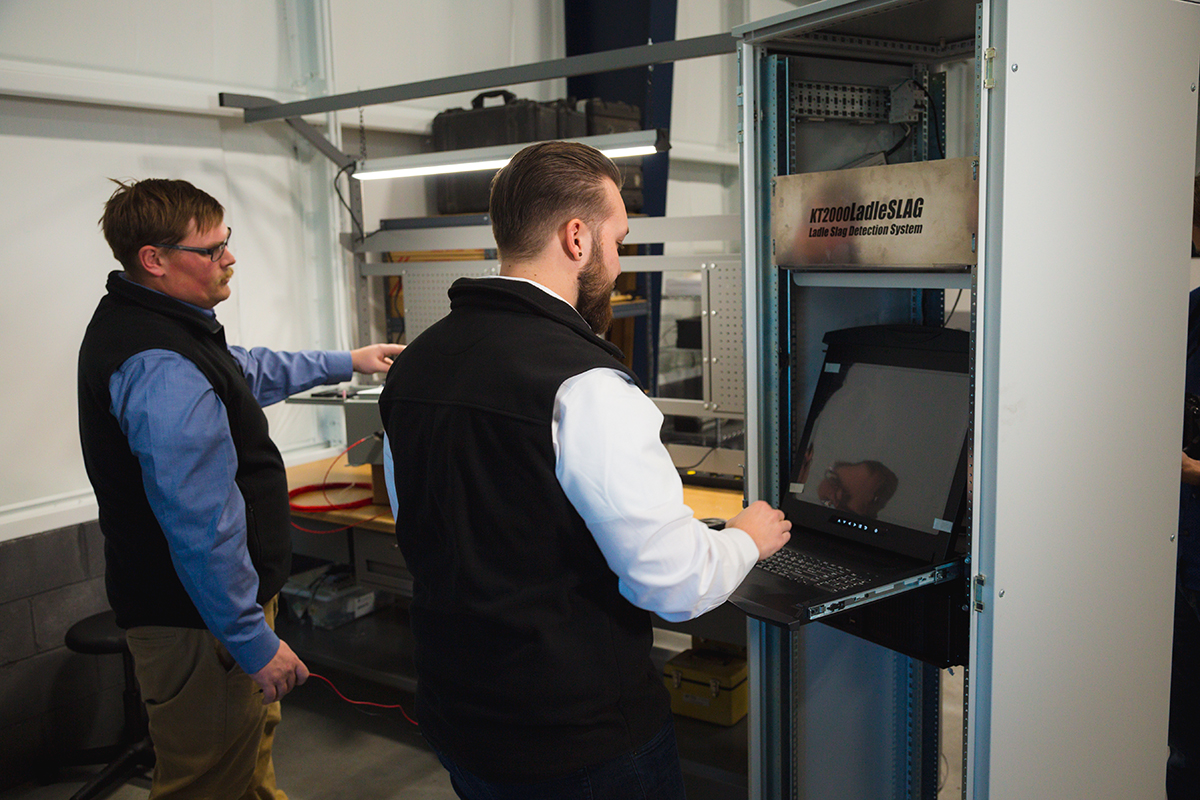
Kiss Technologies’ Ladle Slag Detection System replaces manual visual observation with continuous, objective process monitoring.
Rather than relying on operator interpretation, the system identifies measurable process changes before slag becomes visually apparent, providing operators additional response time while reducing slag carryover into the tundish.
Benefits include:
- Consistent detection independent of operator experience or visibility.
- Earlier identification of the onset of slag carryover.
- Greater confidence in end-of-heat decisions.
- Complete heat-by-heat process records.
- Improved traceability for quality investigations.
- Objective data supporting continuous process improvement.
- Better visibility into operational trends that influence steel cleanliness, yield, and caster performance.
Earlier Detection Supports Both Cleanliness and Yield
Steelmakers constantly balance two competing objectives during ladle draining: maximizing steel recovery while minimizing slag carryover.
Closing the ladle too early sacrifices recoverable steel. Closing it too late allows additional slag to enter the tundish.
Earlier, objective detection gives operators greater confidence in end-of-heat decisions. By identifying the onset of slag carryover sooner and more consistently than manual visual observation, the Kiss Technologies Ladle Slag Detection System helps reduce unnecessary early ladle closure while minimizing slag contamination.
The result is improved yield recovery without compromising steel cleanliness objectives. Better control at the end of every heat can also contribute to longer casting sequences, improved nozzle life, and more predictable production performance.
Visual Detection vs. Kiss Ladle Slag Detection System |
||
| Capability: | Manual Visual Detection: | Kiss Ladle Slag Detection System: |
| Detection basis | Operator observation | Continuous objective process monitoring |
| Consistency | Operator and shift dependent | Repeatable across all heats and operators |
| Detection timing | After visible changes occur | Earlier — before carryover becomes observable |
| Data Collection | None | Complete heat-by-heat records |
| Traceability | Not possible | Full quality and process traceability |
| Trend Analysis | Not possible | Supported — enables continuous improvement |
| Process Optimization | Limited by the absence of data | Data-driven, measurable, ongoing |
The difference is not incremental. It is the difference between a process that varies with every operator and shift, and one that delivers consistent, defensible performance heat after heat.
Slag Detection Frequently Asked Questions
What is visual slag detection in continuous casting?
Visual slag detection is the practice of identifying slag carryover during ladle draining by observing changes in the steel stream’s appearance — such as color shifts, flow variations, or visible slag particles — and manually stopping the ladle drain when slag becomes visible. Because visible indicators are lagging signals, this method requires operators to respond after carryover has already begun, making it inherently less effective than automated detection methods that identify slag onset earlier in the process.
Why is visual slag detection unreliable for controlling steel cleanliness?
Visual detection depends on operator judgment, viewing conditions, and reaction time — all of which vary between individuals, shifts, and heats. This variability makes it impossible to establish consistent end-of-heat performance or reliably prevent slag from entering the tundish. Critically, visual indicators appear only after slag has already begun influencing the stream, meaning contamination is underway by the time corrective action occurs. The result is heat-to-heat inconsistency that directly affects inclusion levels, surface quality, and downstream yield.
How does slag carryover affect non-metallic inclusions and steel cleanliness grades?
When slag enters the tundish, it introduces oxidizing species and reacts with molten steel to generate non-metallic inclusions, including alumina clusters and silicate particles, that degrade cleanliness grades. These inclusions are difficult to remove further downstream and can contribute to nozzle clogging, surface defects, and failures in high-cleanliness applications. Minimizing slag carryover during ladle draining is one of the most direct process controls available to protect inclusion ratings and meet cleanliness specifications.
Does open-stream casting increase the risk of reoxidation and inclusion formation?
Yes. In open-stream operations, the steel stream is exposed to the atmosphere during transfer from the ladle to the tundish. This atmospheric exposure allows oxygen to interact with the molten steel, reversing deoxidation and generating additional oxide inclusions beyond those introduced by slag carryover. The combined effect — slag-sourced inclusions plus reoxidation products — makes open-stream operations with visual detection among the highest-risk configurations for steel cleanliness.
What is the most effective way to reduce slag carryover during ladle draining?
Automated ladle slag detection systems provide the most consistent approach by continuously monitoring the process and identifying slag onset using objective measurements rather than visual observation. Unlike visual methods, automated detection responds to process signals before slag becomes visible, enabling earlier ladle closure, reduced carryover volume, and consistent performance across all heats and operators. The additional benefit of heat-by-heat data records supports ongoing process optimization and quality traceability.
What data does an automated slag detection system provide?
A data-driven slag detection system logs detection timing, ladle draining performance, and carryover events for every heat. This record supports quality traceability — linking tundish contamination events to specific heats — and enables trend analysis that identifies patterns in ladle draining performance over time. For metallurgists managing cleanliness programs, this data provides the objective foundation needed to optimize ladle draining practices, investigate quality events, and demonstrate continuous improvement.
Optimize Steel Cleanliness with Data-Driven Slag Detection
Steel cleanliness is built heat by heat. Every ladle drain is an opportunity to protect steel quality—or introduce variability that affects downstream performance.
Objective slag detection helps steelmakers improve steel cleanliness, recover more quality tons, extend casting sequences, support nozzle life, reduce refractory wear, and provide the heat-by-heat process data needed for continuous improvement.
Contact Kiss Technologies today to schedule a demonstration of the Kiss Technologies Ladle Slag Detection System and learn how objective, data-driven slag detection can improve both metallurgical performance and plant productivity.