
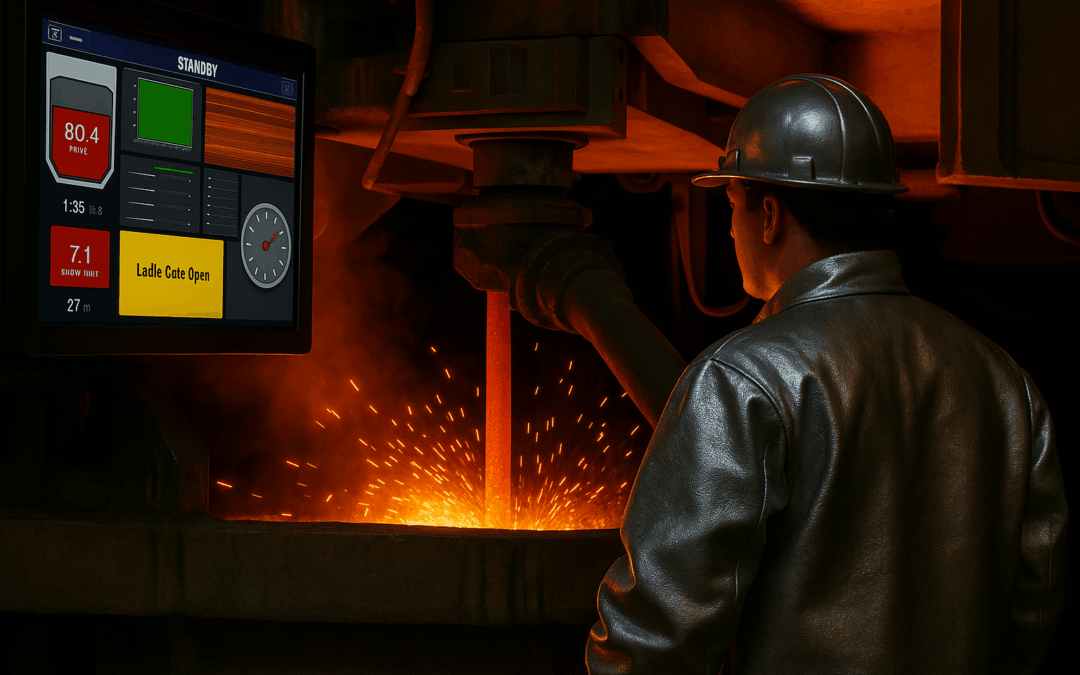
Among the many variables that affect casting yield, the ladle-to-tundish transition remains one of the most difficult to control. In modern steelmaking, continuous casting operations face constant pressure to improve efficiency and reduce loss. Rising energy costs, thinner margins, and fewer skilled operators all demand smarter process control—not just better equipment.
Within this environment, slag detection at the ladle-to-tundish transfer has emerged as one of the most direct ways to improve yield and product quality simultaneously. Even small improvements in how slag carryover is detected and managed can translate into significant economic gains across hundreds of heats per month.
When slag enters the tundish, the impact extends beyond steel cleanliness—it affects yield, refractory life, and overall casting performance. For decades, detection systems have attempted to prevent these losses, but traditional electromagnetic and early acoustic systems struggled to deliver consistent and timely results.
Now, with the integration of artificial intelligence and machine learning, slag detection in steel has evolved from a reactive safeguard into an active yield-control tool. Instead of simply warning operators when contamination occurs, modern systems use data to help determine exactly when and how to end the pour—balancing steel recovery with tundish cleanliness in real time.
The Hidden Cost of Slag Carryover
In continuous casting, yield and quality depend heavily on how effectively slag carryover is controlled during the ladle-to-tundish transfer. Slag itself is a by-product of refining, but once it enters the tundish, its effects are far-reaching—impacting not only steel cleanliness but also downstream productivity and refractory life.
When operators close the ladle too early, clean steel is left behind and yield suffers. When they close too late, slag contamination degrades steel quality and damages tundish refractories. True yield control lies in managing that transition precisely, heat after heat.
Even small amounts of carryover can create cumulative losses across a casting campaign:
- Reduced steel quality, leading to rejections or downgraded product.
- Increased rework and energy use, as contaminated heats require correction or reprocessing.
- Yield loss, when clean steel is discarded with the slag stream.
- Accelerated refractory wear, as slag increases erosion of tundish linings, nozzles, and ladle slag zones—raising maintenance costs and shortening campaign life.
- Operational inefficiency, including unplanned tundish changes, pit cleanup, and added turnaround time between heats.
Across a full production campaign, these losses accumulate—representing thousands of tons of steel and significant downtime. Each of these issues ties back to the same root cause: uncertainty at the ladle end. Without reliable, real-time detection, operators must rely on timing, sight, or experience—methods that vary from shift to shift. AI-based detection changes that dynamic, providing a consistent, data-driven signal that supports yield optimization and quality assurance simultaneously.
Why Traditional Slag Detection in Steel Falls Short
Historically, two primary approaches have been used for ladle slag detection—electromagnetic and early acoustic systems—each with technical trade-offs that limit their ability to deliver consistent yield control.
Electromagnetic systems – Effective in specific conditions, but limited by high installation and maintenance costs, frequent calibration needs, and downtime associated with coil and sensor upkeep. Their sensitivity also decreases over time due to electrical interference and signal drift. Most critically, electromagnetic detection can only sense slag after it has already entered the tundish, providing no opportunity for preventive control. As a result, these systems are reactive rather than predictive—better at confirming a problem than avoiding one.
Early acoustic systems – Easier to retrofit and lower in capital cost, but often disrupted by electrical interference, mechanical vibration, and hydraulic noise common in steel plants. They also depended heavily on accurate ladle weight data, which is frequently unreliable due to drift or inconsistent scale calibration. Under such conditions, operators faced false alarms, missed detections, or conflicting signals that reduced trust in the system.
The outcome was a process that still relied heavily on operator timing and judgment. Ladle closing decisions varied from shift to shift, and yield recovery remained inconsistent. Instead of delivering predictable, measurable control over slag carryover, these systems often introduced additional uncertainty into a process that demands precision.
Enter AI and Machine Learning: Smarter, More Reliable Slag Detection
Artificial intelligence and machine learning have redefined what’s possible in ladle slag detection.
Where older systems offered limited reliability and late response, today’s AI-based acoustic detection provides real-time, predictive insight into the end of the ladle stream—giving operators the ability to manage yield instead of reacting to contamination after it occurs.
The KT2000 GEN2 from Kiss Technologies represents this new generation of detection technology. Built on advanced machine learning infrastructure, it addresses the two primary limitations that long restricted the effectiveness of acoustic systems: plant noise interference and dependence on ladle weight accuracy.
- Noise Immunity – Machine learning models trained on extensive casting data distinguish true slag signatures from the background noise of motors, hydraulics, and mechanical vibration. False alarms are virtually eliminated, allowing for reliable detection in real-world plant environments.
- Weight Independence – Adaptive correction algorithms maintain accuracy even when scale data drifts or becomes unreliable, ensuring consistent performance across different ladles and campaigns.
The result is a system that delivers clear, repeatable feedback at the exact moment it matters most—during the final seconds of the pour. Rather than guessing when to close, operators can make data-driven ladle-end decisions that align with plant goals: minimizing slag entry for clean steel grades or tapping deeper to maximize yield when quality tolerances allow.
By interpreting complex acoustic signals, adapting to process variation, and learning continuously from real production data, AI transforms slag detection into an active process variable—a tool for balancing yield and cleanliness rather than a simple alarm.
Managing Slag Carryover to Optimize Yield
With accurate, real-time feedback, slag detection becomes part of a yield optimization strategy rather than simply a safeguard. The goal of modern slag detection is not always absolute elimination—different production conditions require different strategies:
- Some operations prioritize zero slag transfer to ensure top-tier steel cleanliness.
- Others aim to maximize ladle yield, tapping as deep as possible while still protecting the tundish from contamination.
The KT2000 GEN2 supports both approaches by providing quantitative, real-time feedback that allows operators to manage the ladle-end point precisely. By transforming slag detection from a fixed alarm system into a data-guided control process, GEN2 enables smarter management of the tradeoff between yield and cleanliness—whatever balance each operation targets.
The Economic Benefits of AI-Powered Slag Detection
In continuous casting, even a one-percent improvement in yield or reduction in tundish cleaning frequency can deliver substantial cost savings.
AI-based slag detection in steel directly improves cost-effectiveness by enhancing process consistency and reducing waste.
The Top 5 Benefits of AI-Powered Slag Detection
- Increased Yield
Cleaner tapping means more usable tons per ladle. Plants recover value instead of losing it to over-cautious closure or contamination. - Reduced Rework
Early detection prevents inclusions that lead to time-consuming downstream correction. - Operator Efficiency
With TeemASSIST™ providing guided ladle-end control, operators achieve repeatable results without relying solely on judgment or experience. - Lower Maintenance Requirements
AI-based acoustic systems have no intrusive coils or sensors inside the ladle stream, reducing maintenance and downtime compared to electromagnetic methods. - Continuous Improvement Through Data
Through the Kiss Technologies Data Studio, users can review historical heats, track KPIs, and verify performance trends, while behind the scenes, AI-driven analytics and Kiss Technologies’ engineering team continuously retrain and optimize the models to maintain peak accuracy.
The overall result is a measurable improvement in yield, quality, and consistency—achieved through a smarter use of plant data.
System Example: The KT2000 GEN2 Advantage
The KT2000 GEN2 represents the next stage of evolution in ladle slag detection technology. It combines proven acoustic sensing with adaptive AI machine learning to deliver stable, repeatable detection across every heat.
Technical Highlights:
- Noise-Proof Detection – Immune to vibration, electrical interference, and hydraulic noise.
- Weight-Smart Performance – Corrects for drift in ladle scale data without affecting accuracy.
- Operator Assistance – Real-time ladle-end guidance through TeemASSIST™.
- Cloud-Connected Insight – Data Studio dashboards and reporting for performance validation.
- Ongoing Optimization – Continuous model improvement and field validation supported by Kiss Technologies’ technical team.
Together, these elements turn slag detection into a managed, data-driven process that supports both yield optimization and product quality goals—a shift from reactive alarms to proactive process control.
Looking Ahead: AI as the Standard for Continuous Casting
AI-driven slag detection is rapidly becoming the new benchmark in continuous casting operations. Plants adopting this technology are not just avoiding contamination—they are using slag detection as a yield management tool, balancing steel recovery, tundish cleanliness, and operational cost.
As steelmaking continues to evolve toward higher automation and data integration, systems like the KT2000 GEN2 demonstrate what’s possible when applied machine learning meets practical process control:
- Reliable detection in real operating conditions
- Improved consistency between heats
- Greater yield with reduced rework and downtime
As AI systems mature, slag detection will no longer be an isolated safeguard but part of an integrated casting analytics ecosystem that connects ladle, tundish, and mold performance in real time.
Advancing Efficiency Through Smart Slag Detection in Steel
The application of AI and machine learning has transformed slag detection from a basic safeguard into a strategic process variable. By giving operators control over slag carryover—whether the goal is total elimination or yield maximization—systems like the KT2000 GEN2 are redefining how steelmakers manage yield, quality, and cost in continuous casting.
Explore the Science Behind GEN2
Curious how AI transforms slag detection into yield control? Chat with our team!