
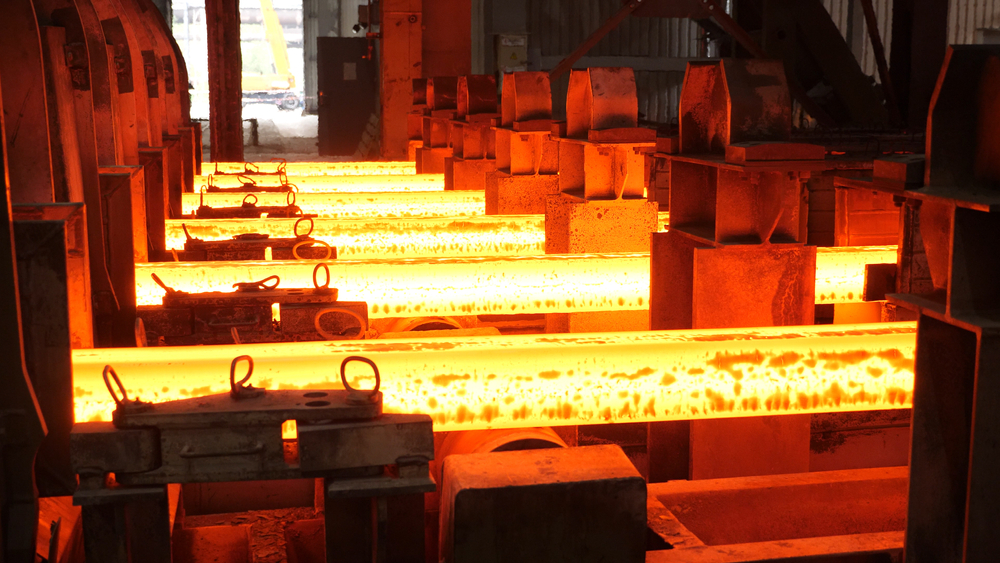
In continuous casting of steel, mold oscillation performance directly impacts surface condition, lubrication behavior, shell development, breakout prevention, and overall caster reliability.
Small changes in oscillator performance can create process instability long before problems become visible in production results. Variations in vibration response, phase, displacement, lubrication behavior, or oscillator synchronization often develop gradually—eventually leading to larger operational and maintenance issues if left unresolved.
That creates a major challenge for operations and maintenance teams preparing for planned downturns or maintenance shutdowns.
Operations and maintenance teams are often forced to determine:
- Which oscillator components require immediate repair
- Which vibration patterns indicate developing mechanical issues
- Which conditions can safely remain in operation
- Where downtime and maintenance resources should be prioritized
Without real oscillator measurement data collected under operating conditions, maintenance decisions are often based on assumptions instead of measurable caster behavior.
KT450 FieldSERVICE was developed specifically to address this challenge.
KT450 FieldSERVICE gives steelmakers a data-driven way to evaluate mold oscillation performance before planned downturns, helping operations teams identify mechanical, lubrication, vibration, and control-related issues early—before they create larger reliability or casting problems.
The result: more effective maintenance planning, reduced unplanned downtime, improved caster reliability, and more stable continuous casting performance.
Why Mold Oscillation Performance Matters in Continuous Casting
Mold oscillation (also known as mould oscillation) in continuous casting is one of the most critical mechanical functions in the caster.
Oscillation performance directly influences:
- Mold lubrication behavior
- Oscillation mark formation
- Shell sticking behavior
- Surface condition
- Breakout prevention
- Mechanical stress on oscillator components
Maintaining stable oscillator performance is essential for controlling lubrication between the mold and the solidifying shell.
Equally important is the correct measurement and setting of oscillation parameters, including:
- Stroke
- Oscillation frequency
- Casting speed
- Negative strip time and ratio
- Mold lead
These parameters define the interaction between mold and strand and directly influence lubrication stability, oscillation mark formation, and breakout prevention.
When oscillator conditions drift outside expected operating ranges, steelmakers may begin seeing:
- Inconsistent oscillation marks
- Lubrication instability
- Increased vibration loading
- Surface condition issues
- Shell sticking behavior
- Reduced casting consistency
- Increased breakout risk
The challenge is that many oscillator-related issues develop gradually over time.
Mechanical wear, linkage looseness, synchronization drift, bearing degradation, vibration harmonics, lubrication inconsistencies, and phase deviations can accumulate across heats and shifts long before they become operationally obvious.
By the time these conditions begin affecting production stability or steel cleanliness, maintenance scope and repair urgency often increase significantly.
That is why predictive mold oscillation analysis has become increasingly important for operations focused on uptime, reliability, and long-term caster performance.
The Problem With Reactive Oscillator Maintenance
Many steel plants still rely heavily on periodic visual inspection or offline mechanical evaluation when assessing oscillator condition.
But periodic visual inspection alone does not provide sufficient visibility into dynamic oscillator behavior during casting.
Oscillator performance changes under loaded casting conditions.
Behavior observed during noncasting inspections often differs significantly from oscillator behavior during live casting conditions, where performance is influenced by:
- Thermal loading
- Casting speed
- Lubrication behavior
- Oscillation tuning (stroke, frequency, negative strip characteristics)
- Dynamic vibration response
- Operational frequency changes
Issues that appear minor during offline inspection may behave very differently once the oscillator is operating under production conditions.
This creates a gap between scheduled maintenance assumptions and actual caster behavior.
As a result, maintenance teams often face one of two costly outcomes:
- Performing unnecessary maintenance on components still operating acceptably
- Missing developing issues that later create casting instability, emergency repairs, or unplanned downtime
Neither approach supports efficient downturn execution or long-term operational reliability.
Effective mold oscillation maintenance requires measurement under real operating conditions—not assumptions based solely on offline inspection.
How KT450 FieldSERVICE Supports Predictive Mold Oscillation Maintenance
KT450 FieldSERVICE is an on-site mold oscillation monitoring and analysis service performed by a Kiss Technologies engineer.
Using a portable monitoring system consisting of:
- An industrial-grade laptop computer
- High-temperature system cables
- Four compact magnetic-base sensors
KT450 FieldSERVICE rapidly evaluates mold oscillator condition under both casting and noncasting conditions.
The service is designed specifically to support predictive maintenance, maintenance prioritization, and continuous casting optimization.

KT450 FieldSERVICE allows steelmakers to:
- Rapidly identify mold oscillator mechanical- and control-related issues
- Prioritize maintenance activities before planned downturns
- Compare oscillator performance during casting and noncasting operations
- Evaluate mold lubrication practices
- Assess oscillator behavior under live caster conditions
Rather than relying solely on inspection intervals or operator observations, teams gain measurable oscillator performance data tied directly to actual caster operation.
What KT450 FieldSERVICE Measures:
KT450 FieldSERVICE evaluates a wide range of oscillator movement, timing, vibration, and casting performance characteristics.
Measurements and calculations include:
- Up/down displacement
- Left/right displacement
- Front/back displacement
- Residual displacement
- Phase
- Rise/fall ratio
- Low-, medium-, and high-frequency vibrations
- Negative strip time and negative strip ratio
- Positive strip time and ratio
- Mold lead
- Measured mold friction (load-based), not a derived vibration-only index
- Oscillation mark depth
These measurements provide operations and maintenance teams with significantly deeper visibility into dynamic oscillator behavior.
Field Insight: Verifying Oscillation Parameters with the Negative Strip Calculator
Accurate measurement is only one part of mold oscillation control. Proper interpretation and validation of oscillation parameters are equally important.
Small changes in stroke, oscillation frequency, or casting speed can significantly alter negative strip time and ratio, often without being immediately visible in operation.
KT450 FieldSERVICE provides direct measurement of these values under actual casting conditions. For quick validation or scenario evaluation, steelmakers can also use the Negative Strip Calculator available on the Kiss Technologies website.
The calculator allows you to:
- Input casting speed, stroke, and oscillation frequency
- Calculate negative strip time and ratio
- Evaluate how parameter changes influence mold/strand interaction
This is a useful tool for:
- Checking oscillation settings after adjustments
- Comparing operating conditions across strands or grades
- Supporting troubleshooting when lubrication or surface condition issues arise
Calculate Your Oscillation Settings in Seconds
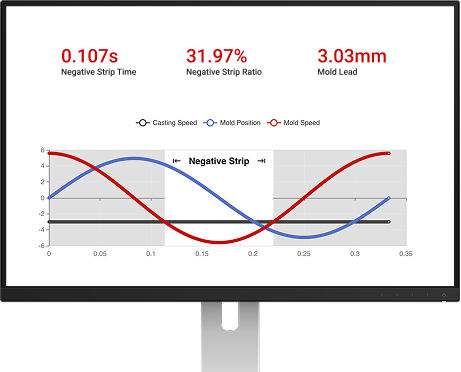
While the calculator is useful for validation, measured performance under real casting conditions remains critical for understanding actual oscillator behavior and identifying mechanical or control-related deviations.
| Measurement Category | Monitored Process Variables & Calculations |
| Multi-Axis Displacement | Vertical stroke, lateral deviation, structural drift, and residual displacement |
| Waveform Dynamics | Phase synchronization, rise/fall ratio symmetry, and waveform consistency |
| Vibration Spectrum Analysis | Low-, medium-, and high-frequency vibration profiles to isolate mechanical anomalies |
| Oscillation Performance Metrics | Negative strip time and ratio, positive strip time, mold lead |
| Mold/Strand Interaction | Measured mold friction (where instrumented) and oscillation mark depth |
Mid-Downturn Problems Usually Start Long Before the Downturn
Many oscillator-related failures do not begin during the maintenance shutdown itself.
They often develop gradually through:
- Mechanical wear
- Eccentric or linkage wear
- Alignment changes
- Bearing degradation
- Hydraulic instability
- Lubrication inconsistencies
- Vibration accumulation
- Control-related instability
- Oscillator tuning deviations
The challenge is that these conditions may remain hidden until production demands amplify them.
That is why short-term online measurement while casting is especially valuable.
KT450 FieldSERVICE can evaluate oscillator behavior during casting, allowing teams to identify:
- Heat-dependent vibration patterns
- Dynamic displacement instability
- Resonance behavior
- Performance changes under load
- Differences between loaded and unloaded oscillator conditions
- Developing mechanical or control-related deviations
This gives operations managers significantly better visibility into which repairs are truly urgent before maintenance shutdowns begin.
Download the KT450 FieldSERVICE PDFWant a closer look at how KT450 FieldSERVICE evaluates mold oscillation performance under real casting conditions? Download the product sheet to review:
|
Better Maintenance Planning Requires Better Oscillation Data
For operations and maintenance managers, efficiency is not simply about completing repairs.
It is about prioritizing the right repairs.
When oscillator performance is evaluated before a planned downturn:
- Maintenance scope becomes more targeted
- Repair planning becomes more efficient
- Critical issues are identified earlier
- Unnecessary maintenance can be reduced
- Downtime exposure decreases
That directly supports:
- Higher caster reliability
- More stable continuous casting performance
- Improved operational efficiency
- Better long-term equipment life
Unplanned oscillator failures rarely impact only maintenance schedules.
They can also affect:
- Casting throughput
- Strand stability
- Surface condition
- Lubrication consistency
- Maintenance scope
- Overall caster productivity
Identifying developing oscillator issues before planned downturns allows steelmakers to allocate maintenance resources more effectively while minimizing operational disruption.
Mold Oscillation Monitoring Is Becoming a Long-Term Reliability Strategy
As continuous casting operations continue pushing for higher productivity, tighter steel cleanliness requirements, and improved uptime, oscillator performance can no longer be treated as a secondary maintenance item.
Mold oscillation directly influences:
- Surface condition
- Oscillation mark consistency
- Lubrication performance
- Mechanical reliability
- Breakout prevention
- Maintenance costs
- Unplanned downtime risk
The most effective steelmakers are moving toward predictive, data-driven maintenance strategies that identify developing oscillator issues before they impact production.
KT450 FieldSERVICE supports that transition through real-world oscillator measurement, vibration analysis, and operational expertise.
By combining detailed oscillator monitoring with decades of continuous casting experience, Kiss Technologies helps steelmakers prioritize the repairs that matter most—before planned downturns.
FAQ: Mold Oscillation Monitoring in Continuous Casting
What is mold oscillation in continuous casting?
Mold (mould) oscillation in continuous casting is the controlled vertical movement of the mold used to prevent shell sticking and maintain lubrication between the mold and the solidifying steel shell.
Oscillation performance directly impacts surface quality, oscillation mark formation, lubrication behavior, and breakout prevention.
Why is mold oscillation monitoring important?
Mold oscillation monitoring helps steelmakers identify developing mechanical, vibration, lubrication, and control-related issues before they create casting instability or unplanned downtime. Real-time oscillator measurement supports predictive maintenance and more effective outage planning.
What does KT450 FieldSERVICE measure?
KT450 FieldSERVICE measures and analyzes:
- Mold displacement
- Oscillation phase
- Rise/fall ratio
- Negative strip time
- Mold lead
- Friction index
- Low-, medium-, and high-frequency vibrations
- Oscillation mark depth
These measurements help operations teams evaluate oscillator condition under both casting and noncasting operating conditions.
How does KT450 FieldSERVICE help during planned outages?
KT450 FieldSERVICE helps prioritize outage repairs by identifying which oscillator components and operating conditions require attention before shutdowns begin. This allows maintenance teams to focus outage resources on the highest-priority issues while reducing unnecessary maintenance activity.
Can mold oscillation issues affect steel quality?
Yes. Poor mold oscillation performance can contribute to:
- Surface defects
- Inconsistent oscillation marks
- Lubrication instability
- Shell sticking
- Increased breakout risk
- Casting instability
Maintaining proper oscillator performance is critical for stable continuous casting operation and consistent steel quality.
Maximize Your Maintenance Window
KT450 FieldSERVICE gives your team the data needed to evaluate oscillator condition, prioritize maintenance activities, and improve continuous casting reliability with confidence.
Partner with a Kiss Technologies engineer to benchmark your strands under load and build a data-driven repair plan before the next downturn.